
Right, let’s talk about something that’s been winding me up lately. You buy a new car, you’re absolutely chuffed with it, and then about three months later you get a letter from the main dealer. “Time for your first service!” they chirp. You ring them up for a quote and nearly drop the phone. Two hundred and fifty quid? For an oil change and a once-over?
But here’s the kicker most people pay it. Why? Because they genuinely believe if they don’t, their warranty’s toast. I had a mate in Bletchley who drove past three perfectly good independent garages to get to his Vauxhall dealer because he was convinced he had no choice.
Spoiler alert: he absolutely did have a choice. And it’s costing British drivers a small fortune that they just don’t need to spend.
The Big Warranty Myth (That Dealers Won’t Correct)
Let me be crystal clear about this: you don’t have to use a main dealer to keep your warranty valid. Full stop. End of story.
This has been the law since theMotor Vehicle Block Exemption Order came in, and Brexit hasn’t changed it. As long as your car’s serviced properly – right schedule, right parts, proper records – your warranty stands. Doesn’t matter if it’s done at a gleaming dealership in Central Milton Keynes or a family-run garage tucked away in Stony Stratford.
Now, the dealers aren’t exactly going to put this in big bold letters on their service reminders, are they? Can’t really blame them – it’s how they make a chunk of their money. But you deserve to know the truth, especially when you’re looking at potentially hundreds of pounds difference.
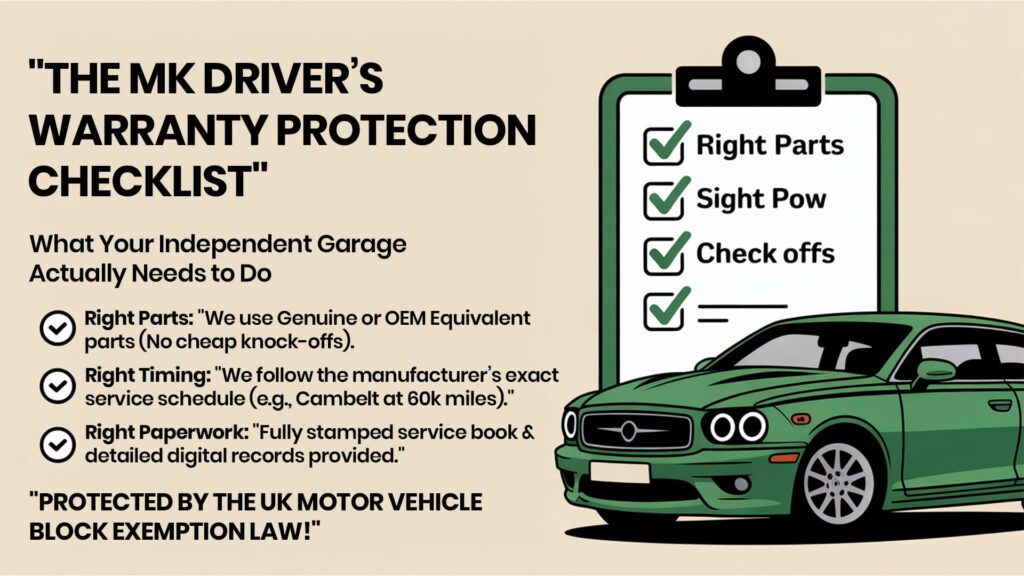
What Your Independent Garage Actually Needs to Do
Here’s where it gets a bit less straightforward, because not just any garage will do. Your independent needs to tick some pretty important boxes:
They’ve got to use the right parts. That means either genuine manufacturer parts or what’s called “OEM equivalent” – basically parts made to exactly the same spec, just without the fancy badge. A decent garage will show you the paperwork proving this if you ask.
They need to follow your car’s service schedule to the letter. If your handbook says cambelt at 60,000 miles, it’s got to be 60,000 miles. Not 65,000 because you forgot about it, not 55,000 because the garage had a quiet week. Spot on.
And this is the big one – they must keep proper records. I mean properly proper. Stamped service book, detailed invoices with part numbers, dates, the lot. Because if something does go wrong and you need to make a warranty claim, those records are your proof you’ve done everything right.
The RAC reckons most warranty claims that get knocked back aren’t rejected because of where the service was done. It’s usually dodgy paperwork or corners being cut on the actual work.
Let’s Talk Money (Because That’s What This Is Really About)
Alright, practical example time. You’ve got a Ford Focus – dead common round here – and it needs its annual service.
Pop down to the Ford dealer and you’re looking at anywhere between £200 and £350, depending on whether it’s a minor or major service. Same car, same work, done at an independent garage with Ford-trained mechanics? You’ll probably pay £120 to £200.
Do that over three years while you’re in warranty and you’ve saved yourself £300 to £450. That’s a decent holiday, or a chunk off your car insurance, or just money that stays in your pocket instead of going into a dealership’s coffers.
And look, I get it – times are tight. Energy bills are mental, the weekly shop costs more every time, and petrol’s not exactly cheap. If there’s a legitimate way to save a few hundred quid without any risk, you’d be daft not to take it.
When the Main Dealer Actually Makes Sense
Before you all think I’ve got some vendetta against main dealers, let me throw in some balance. There are times when using them is genuinely the smart move.
If there’s a recall on your car, or something goes wrong that’s definitely covered by warranty, let the main dealer handle it. They’ve got direct lines to the manufacturer, all the technical bulletins, and they’ll sort it for free. Why would you go anywhere else?
Similarly, if your car’s got some weird electrical fault that’s got everyone baffled, or it needs a software update, the main dealer’s diagnostic kit is usually better. Though I will say, some of the better independents have seriously upped their game on this front recently.
And if you’ve just bought a brand new motor and you’re feeling a bit precious about it (no judgement, I was the same with my Audi), there’s nothing wrong with paying for main dealer peace of mind in that first year or two. It’s your money and your choice.
Finding Someone You Can Trust Round Here
This is probably the most important bit, because not every garage with “independent” on the sign is up to scratch.
First things first: look for trade body memberships. The Independent Garage Association and the Motor Ombudsman are the big ones. If a garage is signed up to these, they’ve had to meet certain standards, and you’ve got somewhere to complain if things go pear-shaped.
Check Google reviews, but don’t just look at the star rating. Read the actual reviews. What are people saying? Are they detailed? Do they mention specific services? And here’s a good test – look at how the garage responds to bad reviews. If they’re defensive and snippy, red flag. If they’re trying to make it right, that’s a good sign.
Pop in and ask some questions before you book anything. Where do they get their parts? Can you see their technicians’ qualifications? How do they keep service records? A good garage won’t be bothered by this – they’ll be happy you’re asking. If they get arsey about it, there’s your answer.
I know a couple of lads who found brilliant independents just by asking around at work and in the local Facebook groups. Word of mouth still counts for a lot.
The Service Book Situation
Quick heads up on something that’s caught a few people out: loads of new cars don’t have physical service books anymore. It’s all digital now, updated by the dealer electronically.
If your car’s one of these, your independent garage either needs access to that system (some do, especially for popular makes like Ford, Vauxhall, VW), or they need to give you paperwork so detailed there’s absolutely no room for doubt about what was done and when.
If you’ve still got an old-school service book, make sure it gets stamped. I know it seems a bit old-fashioned, but when you come to sell the car, a fully stamped service book is worth its weight in gold. Trust me on this one.
So What’s the Verdict?
Look, the bottom line is this: using an independent garage won’t void your warranty. What will potentially void it is shoddy servicing, missed services, or not being able to prove the work was done properly. And those risks exist wherever you go, whether you’re paying dealer prices or not.
The trick is finding an independent you can trust, making sure they’re doing everything by the book, and keeping hold of all your paperwork. Do that, and you can save yourself a serious chunk of money without losing a wink of sleep over your warranty.
Your car doesn’t know whether it’s being serviced at a fancy dealership or a no-nonsense independent workshop. But I guarantee your bank account will notice the difference.