Look, if you’re running any kind of business in Milton Keynes that relies on a commercial van, you already know how much you depend on that thing. Doesn’t matter if you’re doing deliveries, plumbing jobs, or hauling equipment around your van breaking down or, worse, getting taken off the road is basically a disaster waiting to happen.
Here’s the problem though: loads of van drivers don’t realize that getting an MOT for a commercial vehicle is completely different to getting one for your family car. I’ve lost count of how many times someone’s rolled up here at MK12 Autocare genuinely shocked that their local garage can’t test their van, or that they need testing every single year, not every three.
So let me walk you through what a Class 7 MOT actually is, when you need one, and more importantly how to avoid the headaches that come with getting it wrong.
What’s a Class 7 MOT When It’s at Home?
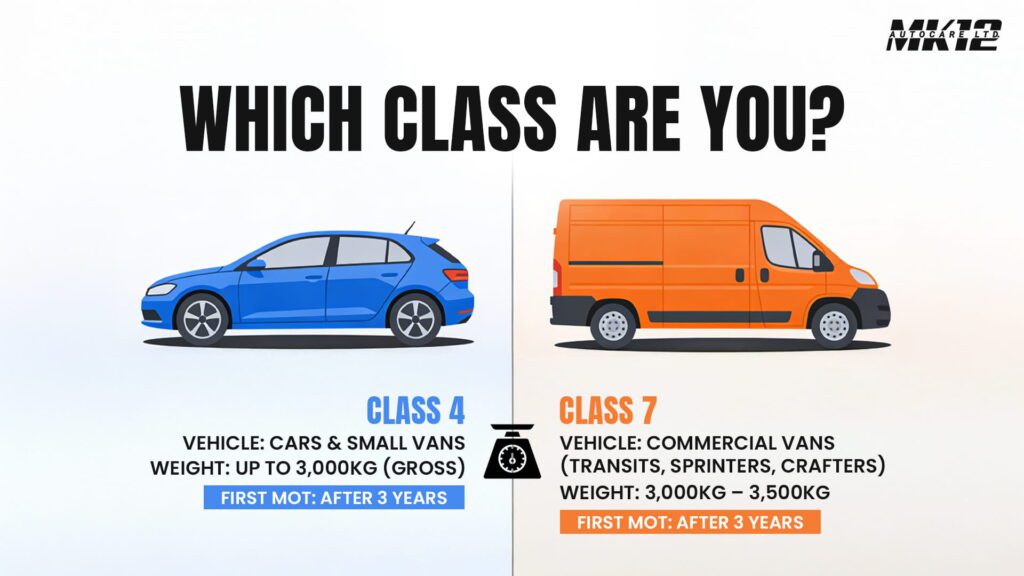
Alright, so MOT tests aren’t just one-size-fits-all. They’re split into different classes depending on what you’re driving. Your average car? That’s Class 4. But your bigger commercial vans anything between 3,000kg and 3,500kg need a Class 7 MOT instead.
We’re talking about your Transits, Sprinters, Crafters, those kinds of workhorses you see all over Milton Keynes. Basically, if you’re driving a proper-sized commercial van but don’t need an HGV licence for it, you’re in Class 7 territory.
Now, here’s the kicker: your local garage down the road might be absolutely brilliant at testing cars, but unless they’ve got the specific equipment and DVSA approval for Class 7, they literally can’t test your van. The equipment’s different, the testing standards are different, everything’s different.
Finding the best Class 7 MOT Service in Milton Keynes means finding somewhere that’s actually set up properly for commercial vehicles. We’re not talking about a garage that “can probably squeeze you in” you need somewhere that does this day in, day out, and knows what they’re looking at.
When Do You Actually Need This Test?
Right, this catches people out all the time. With a regular car, you get three years before your first MOT. Nice and relaxed. Commercial vans? One year. That’s it. Twelve months from when it was first registered, and you’re due for testing. Then it’s every year after that, no exceptions.
I know what you’re thinking seems a bit harsh, doesn’t it? But think about how hard your van works compared to a family car. You’re probably doing 30,000 miles a year, maybe more. That’s two or three times what most cars cover. You’re loading heavy stuff in and out, you’re stopping and starting constantly, you’re probably driving in all weathers. Everything wears out faster.
Your V5C logbook has the exact registration date on it. Stick that date in your phone calendar right now, seriously. And set yourself a reminder for a month before as well, because leaving it to the last minute is asking for trouble.
Miss your MOT date and you’re driving illegally. Simple as that. Police stop you and let’s be honest, a scruffy-looking van is basically a magnet for a pull-over and you’re looking at a grand in fines. Your insurance goes out the window too, which is absolutely the last thing you need if something goes wrong.
Why Is Class 7 Testing So Different?
You might think a test is a test, right? Stick it on the ramp, check the lights work, test the brakes, done. If only it was that simple.
Class 7 tests take about 90 minutes, sometimes longer if there are issues. That’s double what a car test takes, and there’s a good reason for it. Your van’s working harder, carrying more weight, and the standards it needs to meet are considerably higher.
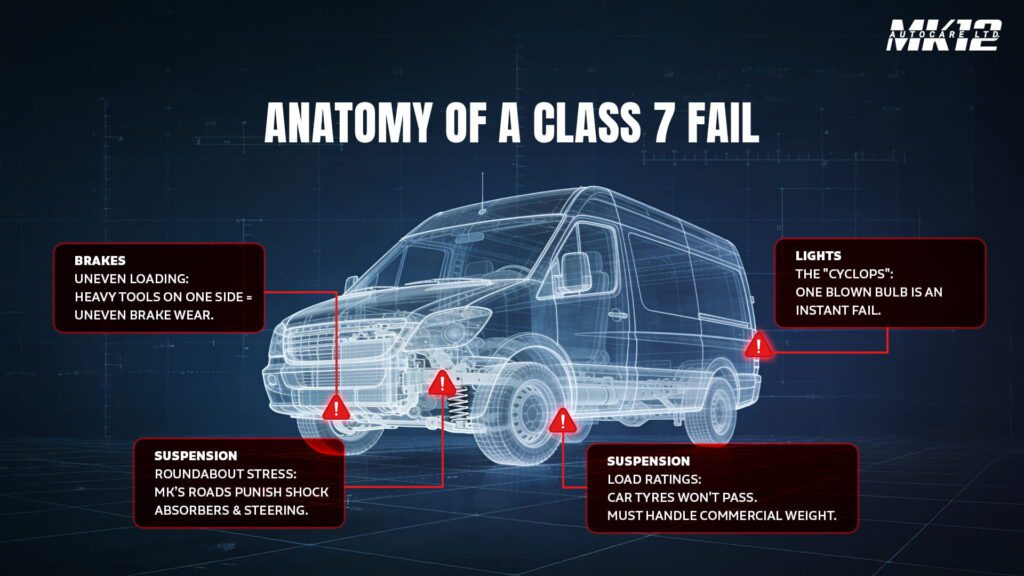
Everything gets looked at more thoroughly. Your brakes need to work properly when you’re loaded up with gear, so the testing’s more rigorous. The brake rollers they use for vans are completely different heavier duty, higher standards. A braking performance that might scrape through on a car could easily fail on a van.
Suspension and steering get properly scrutinized too. Think about it your van’s loaded up, you’re going round Milton Keynes’ endless roundabouts all day, that puts massive stress on everything underneath. Any wear, any play in the steering, tired shock absorbers it all gets picked up.
Tyres are a big one. They check the load rating’s right for your van, they measure tread depth across the whole width of the tyre, they look at sidewall condition. Commercial tyres take a battering, and the testers know exactly what to look for.
The Stuff That Always Catches People Out
We see the same failures week after week here, and honestly, most of them are so easy to avoid if you just keep an eye on things.
Brakes going wrong on one side is massive. If you always chuck your heavy tools on one side of the van, or you’ve got racking that’s heavier on one side, your brakes wear unevenly. The tester spots it instantly on the rollers. Try to spread weight around a bit more evenly, yeah? And get your brakes checked regularly, not just when you think there’s a problem.
Worn tyres catch loads of people. You think they look alright, but when the tester actually measures them properly, you’re under the legal limit. I see it constantly. Check your tyres monthly get yourself a cheap tread depth gauge, they’re like three quid. If you’re down to 3mm, you need to start thinking about replacements soon.
Lights that have packed in seem dead obvious, but you’d be amazed. You’re driving around all day, you don’t notice one brake light’s gone or an indicator’s not working. Do a proper check every week. Get your mate or your partner to stand behind the van while you test everything. Takes literally two minutes.
Exhausts blowing is another one. You think “ah, it’s just making a bit more noise, I’ll sort it later.” Later becomes MOT day, and suddenly it’s a failure and you’re stuck. If your exhaust sounds different, get it looked at. Don’t wait.
Keeping Things Legal Between Tests
Passing your MOT once a year is all well and good, but you need to stay legal the rest of the time too. It’s not like your van magically stays perfect for twelve months just because it passed a test.
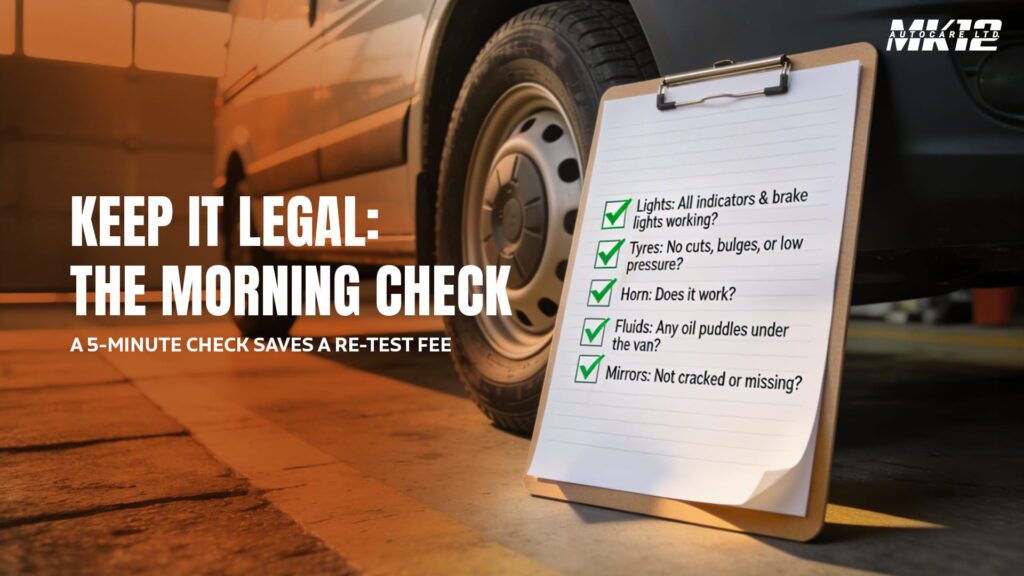
Quick walk around every morning before you start work. Flat tyre? Obvious damage? Lights broken? Oil leak underneath? Spot these things early, you can sort them before they become proper problems.
Once a week, do a more thorough check. All your lights, horn, tyre pressures, that kind of thing. Once a month, check your oil properly not just a quick glance, actually pull the dipstick out and look. Check your brakes through the wheels if you can see them.
And for crying out loud, don’t skip your annual service to save a few quid. Honestly, it’s the dumbest false economy going. A well-serviced van passes its MOT easier, breaks down less, and costs you less in the long run. The best Class 7 MOT Service in Milton Keynes will do you a combined service and MOT package that actually saves you money anyway.
What Happens If You Try to Cut Corners?
Some people think they can wing it. Skip the MOT, keep driving on a fail certificate, bodge repairs themselves. Look, I get it you’re busy, money’s tight, you need the van on the road. But it’s genuinely not worth the risk.
Get caught without a valid MOT and that’s a grand in fines immediately. But worse than that, your insurance is invalid from the second your MOT expires. You have an accident doesn’t even need to be your fault and you’re personally on the hook for everything. Your van, their van, medical costs if someone gets hurt, the lot. It’s an absolute nightmare.
If you’re self-employed, HMRC won’t accept your mileage claims if you’re driving illegally. If you’ve got employees driving your van, you could end up in serious legal trouble if something goes wrong. All because you tried to save a couple of hundred quid on an MOT.
Being Smart About It
Best thing you can do? Book your MOT at least a month before it’s due. That way, if something fails, you’ve got time to get it fixed without panicking. You can shop around for parts, do some of the simpler stuff yourself if you know what you’re doing, whatever.
Some garages we do this at MK12 Autocare will do a pre-MOT inspection. Costs maybe fifty quid, but they’ll tell you what’s likely to fail before you actually book the test. Then you can get it sorted on your own terms instead of being stuck after a failed test with no van and jobs you can’t get to.
Try to get your service and MOT done together. Most people find that easiest. Book them both for the same day, drop the van off early, pick it up later. The best Class 7 MOT Service in Milton Keynes will bundle them together and save you money anyway.
Finding Somewhere Decent to Get It Done
Not every garage is up to scratch for commercial vehicles. You need somewhere that actually knows what they’re doing with Class 7 testing, not somewhere that’s just winging it.
We’ve been doing this for years at MK12 Autocare. We’re properly DVSA-approved for Class 7, we’ve got all the right equipment, and our mechanics actually understand commercial vehicles. We’re not car mechanics trying to muddle through with vans we know the differences and we know what matters.
We get that your van is basically your business. Can’t work without it, simple as that. So we’ll work around you early starts, late finishes, whatever helps. If your van’s in decent nick, we can usually turn it around in a morning so you’re not losing a whole day.
If something needs fixing, we’ll show you what and explain why. Sometimes it’s a quick fix we can do there and then. Sometimes you might want to get your own parts or think about it. Either way’s fine by us we’re not here to pressure you into stuff you don’t need.
Your van’s too important to mess about with. Book your Class 7 MOT with us online or just give us a ring. Let’s keep you legal and on the road, yeah?